Torre de' Rossi
Borgo S. Jacopo 3/R
HISTORY
The origins
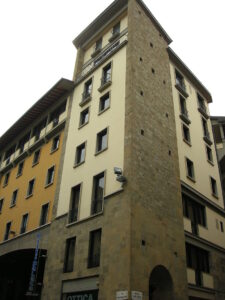
The tower was built in the thirteenth century by the Guelph family of the Rossi d'Oltrarno, originally from Fiesole. Subsequently, the tower passed to the family of the Cerchi and later came hereditary to the Canigiani.
"sarieno i Cerchi nel piovier d’Acone..."
[Dante Alighieri, Paradiso, XVI, 65]
Dante cites the Cerchi family at various points, often indirectly, and accuses them of his downfall for their foolish leadership of the Guelfi Bianchi party. Ciacco in the sixth song of Hell calls them "the wild part", in other words rustic, of the countryside, while Cacciaguida in the sixteenth song of Paradise says with some regret, that if there were no conflicts between Pope and emperor, perhaps many families that became Florentine would have remained in the countryside, for example "sarieno i Cerchi nel piover d'Acone"( Translation: The Cerchi family would have remained with the people of Acone, a little village in the Tuscan countryside).
THE STREET
BORGO SAN JACOPO
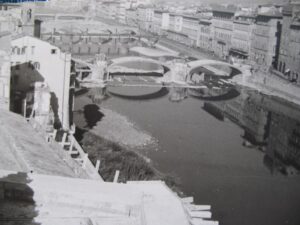
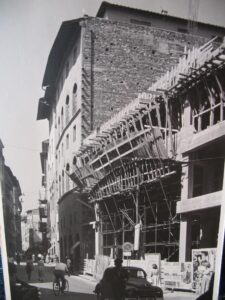
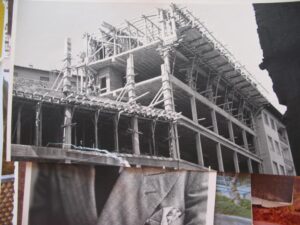
The name already reveals part of the history of the street: the "borghi" were in fact in Florence those streets that came out of the city in correspondence of one of the ancient gates of the medieval walls. On the night of 3-4 August 1944, the fleeing Germans, to delay the arrival of the allied forces and partisans, blew up all the bridges in Florence. They only one that avoided the bombing was Ponte Vecchio, but they also destroyed all the streets adjacent to that bridge, including Borgo San Jacopo.
MUST-SEE
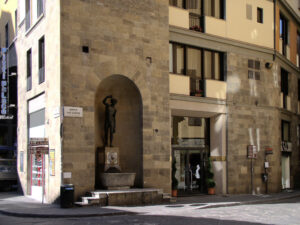
The Bacchino fountain
In 1838, on the ground floor of the side overlooking Borgo San Jacopo was set up a fountain with a bronze statue depicting Bacchus, a juvenile work of Giambologna (about 1560), commissioned by Lattanzio Cortesi and purchased by the Medici in 1638. The statue, which had enjoyed very little popularity in the Neaclassical period, after being placed in a secluded position in the Uffizi, was placed in 1825 at the Ponte Vecchio. The statue was replaced by a copy, made by the Fonderia Artistica Ferdinando Marinelli of Florence, only in 2006 and musealized at the Bargello.
PICTURES

Rossi tower
Borgo S. Jacopo, 3/R
Florence, Italy

Lungarno view
Borgo S. Jacopo, 3/R
Florence, Italy

Bacchino fountain
Borgo S. Jacopo, 3/R
Florence, Italy

Rossi tower
Borgo S. Jacopo, 3/R
Florence, Italy

Construction site
Borgo S. Jacopo, 3/R
Florence, Italy